
At first glance, a drone battery appears to be nothing more than a collection of cells connected in series and parallel, encased in a shell with a protection board (though some lack the latter). However, the factors that truly determine whether the battery ensures stable flight, supports high-power discharge, and offers a long lifespan are established *before* assembly: cell capacity grading and sorting.
This is particularly critical in scenarios involving high-current discharge, rapid ascent, sudden acceleration, low-temperature flight, and frequent charge-discharge cycles; the requirements for cell consistency here far exceed those for standard consumer-grade batteries. If even a single cell in the pack “drags its feet,” the entire pack’s usable capacity, instantaneous power output, safety limits, and cycle life are constrained by that one cell.
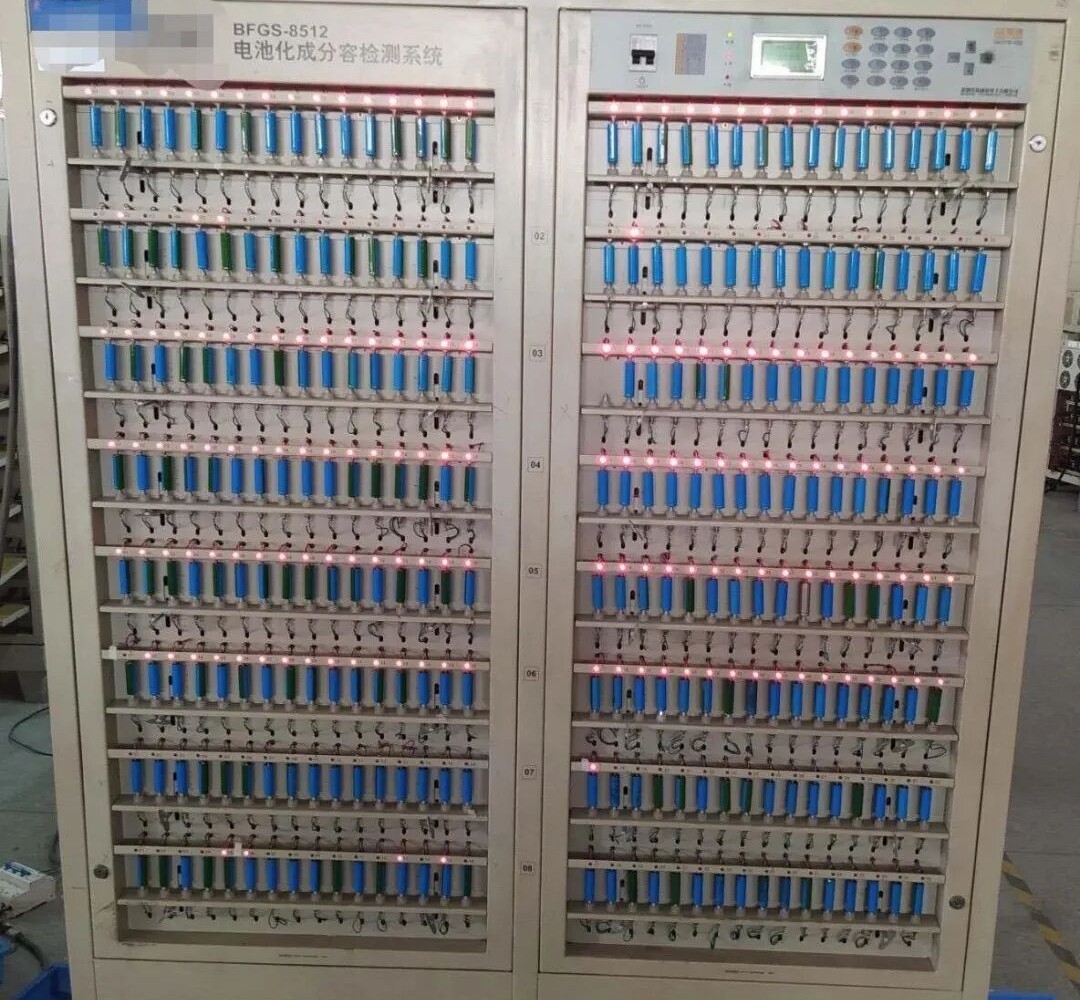
I. What is capacity grading?
Simply put, capacity grading involves using standardized charge-discharge tests to measure the actual capacity of each individual cell and then categorizing them based on capacity ranges.
Even when cells share the exact same model and batch, achieving perfect uniformity across every unit is impossible. Factors such as coating thickness, electrode compaction density, electrolyte fill volume, formation status, minute variations in the separator, and the production environment all lead to differences in capacity, internal resistance, self-discharge rates, and discharge rate performance.
Therefore, capacity grading is not a superfluous step; it is a process of re-evaluating cells that appear identical based on their actual performance. For drone batteries, the goal isn’t merely to identify “high-capacity cells,” but to find cells with similar performance characteristics and stable states that are suitable for being paired together in a pack.
II. Why do drone batteries specifically require capacity grading?
Battery packs are typically composed of multiple cells connected in series—configurations such as 4S, 6S, or 12S. A fundamental characteristic of a series configuration is that the performance of the entire pack is limited by the weakest cell string.
If one string has lower capacity, it will hit the low-voltage cutoff threshold first during flight. This triggers the BMS (Battery Management System) or flight controller to issue early warnings, limit power output, or even initiate safety shutdowns. Consequently, the entire pack can no longer safely deliver power, even though the other cells may still hold a charge.
If a specific string has higher internal resistance, it will experience a more pronounced voltage drop and a greater temperature rise during high-current discharge. During rapid acceleration, wind resistance, or full-load climbing, a specific cell might experience a voltage drop before the others, causing the voltage of the entire pack to collapse. This manifests as a sudden reduction in flight time and sluggish power delivery; in severe cases, it can compromise flight safety.
If a specific cell in the series exhibits excessive self-discharge, its voltage will lag behind the others after prolonged storage. During recharging, the higher-voltage cells may reach full charge while the lower-voltage ones remain undercharged, further degrading pack consistency; the disparity widens with each subsequent cycle.
Therefore, the essence of capacity grading is to ensure cell consistency. A drone battery’s performance depends not on the peak specifications of an individual cell, but on whether the group of cells remains “in sync” under high loads.
III. What key parameters are considered during capacity grading?
1. Capacity: This is the fundamental metric determining the battery pack’s baseline runtime, usually expressed in mAh or Ah. The closer the capacities are, the easier it is to maintain consistent States of Charge (SOC) when connected in series. However, there is a common misconception: high capacity does not necessarily make a cell suitable for a specific pack. For instance, in a batch of cells, some might be 5200mAh while others are 5050mAh. If mixed into a single pack, the nominal capacity might look impressive, but in actual use, the lower-capacity cells will deplete first, effectively limiting the entire pack’s usable capacity to that of the weakest cell. A more professional approach involves grouping cells by capacity tiers—keeping the capacity variance within a tight range for a given set. For high-discharge-rate drone batteries, superior capacity consistency results in a smaller voltage differential at the end of discharge, ensuring greater stability during the latter stages of flight.
2. Internal Resistance (IR): This determines high-current output capability and heat generation; it is a critical parameter for drone batteries. While capacity dictates “how much energy can be stored,” internal resistance determines “how smoothly that energy can be released.” Higher internal resistance leads to a more pronounced voltage drop and increased heat generation during high-current discharge. The relationship can be simplified as follows: heat generation is proportional to the square of the current and the internal resistance. Drone batteries frequently handle outputs of tens or even hundreds of amperes, so even slight differences in internal resistance can significantly amplify temperature rise and voltage drop. During sorting, it is essential to consider not only the absolute internal resistance value of individual cells but also the variance in internal resistance among cells within the same group. In a series-connected battery string, the cell with the highest internal resistance bears the greatest power loss; consequently, it runs hotter and ages faster. Over time, this cell weakens further, creating a vicious cycle. It is important to note that there are different testing methods for internal resistance, such as ACIR (AC internal resistance) and DCIR (DC internal resistance). Standard internal resistance meters typically measure ACIR, which is suitable for rapid screening; however, for high-discharge-rate applications like drones, one should focus more on DCIR and voltage drop characteristics under pulsed discharge conditions.
3. K-Value: Assessing Self-Discharge and Potential Defects. The K-value can generally be understood as the rate of voltage drop while the cell is at rest, typically measured in units like mV/day. It reflects the cell’s self-discharge rate and helps identify potential issues such as micro-shorts, impurities, separator defects, or packaging anomalies. A cell that passes capacity and internal resistance tests immediately after formation does not necessarily guarantee long-term stability. A significant voltage drop after a few days of rest suggests the presence of an internal leakage path. If such a cell is used in a drone battery pack, it can lead to voltage imbalances during long-term storage and even pose safety risks. Significant discrepancies in K-values among cells in a pack can result in uneven voltage levels after a full charge and a rest period—where some cells remain at 4.2V while others drop to 4.1V. This imbalance causes specific cells to hit the cut-off voltage prematurely during discharge, triggering low-voltage protection or—in systems without a BMS—leading to cell over-discharge and permanent damage. Therefore, the K-value is not an optional parameter but a crucial indicator for screening cell stability. For drone batteries, capacity and internal resistance determine immediate performance, while the K-value determines long-term stability.
4. Voltage Plateau: Determining Output Stability During Flight. Cells with identical capacities can exhibit different discharge curves. Some cells maintain high voltage initially but experience a rapid drop later, while others offer a flatter, more stable voltage plateau. Drone flight involves not just slow, low-current discharge, but sustained high loads combined with instantaneous power surges. A stable voltage plateau ensures reliable power delivery to the flight controller, electronic speed controllers (ESCs), and motors. Conversely, significant variations in the voltage plateau can lead to issues such as inaccurate battery level readings, rapid voltage drops during the latter stages of discharge, and premature low-voltage alarms. Therefore, effective sorting goes beyond merely considering the total discharge capacity; it also focuses on whether the voltage curves during discharge are closely matched.
5. Temperature Rise: A reflection of true high-rate capability. Drone batteries cannot be tested solely under standard, low-current conditions. Many cells perform well at 0.2C or 0.5C but exhibit significant temperature rise, substantial voltage drop, and low efficiency during high-rate discharge. A high temperature rise indicates significant internal losses and implies a reduced safety margin. Prolonged operation at high temperatures accelerates electrolyte decomposition, SEI layer thickening, and electrode degradation, ultimately manifesting as capacity fade, increased internal resistance, and a higher risk of swelling. Consequently, for drone cells, it is best to incorporate high-rate discharge testing and use temperature rise as a key screening criterion.
V. Conclusion
In short, given current technological capabilities, even batteries produced on the same line in the same batch exhibit subtle differences. By using capacity grading to assemble packs from cells with similar capacity, internal resistance, and voltage drop characteristics, one can ensure better consistency during charge and discharge cycles. This prevents the overall pack’s capacity or lifespan from being compromised by individual cells whose voltage drops too rapidly.
Battery packs that have not undergone rigorous capacity grading and sorting may function initially, but as the number of cycles increases, the disparities between cells will widen. This eventually manifests as reduced flight time, increased voltage differentials, inability to fully charge, rapid power loss, and excessive heat generation—or even swelling and safety risks. Therefore, capacity grading is not merely a simple step; it is a core component of quality control for drone batteries.
For high-rate drone batteries, a truly superior pack is not defined by a single cell with impressive specifications, but rather by the ability of the entire set of cells to maintain consistency, stability, and controllability during every phase of flight—takeoff, climbing, hovering, and returning to base.