
For drone professionals and pilots, “long endurance” and “high maneuverability” have always been mutually exclusive goals. At the heart of this industry challenge lies the inverse relationship between energy density and rate capability inherent in lithium-ion battery systems—a fundamental trade-off dictated by material composition and structural design, and a core issue in the quest for technological breakthroughs in drone batteries. This article deconstructs the underlying mechanisms of this conflict from the perspective of battery cell design and explores the disruptive transformations that technologies such as solid-state batteries will bring to the industry.
I. Definitions of Energy Density and Rate Capability
Energy density refers to the electrical energy a battery cell can store per unit of mass or volume (measured in Wh/kg or Wh/L); it directly determines the drone’s maximum flight endurance. C-rate performance refers to a cell’s ability to charge and discharge at high currents (measured in C, where 1C represents the current required to fully discharge a cell in one hour); this directly determines the drone’s heavy-load capacity, fast-charging speed, and discharge stability under extreme operating conditions.
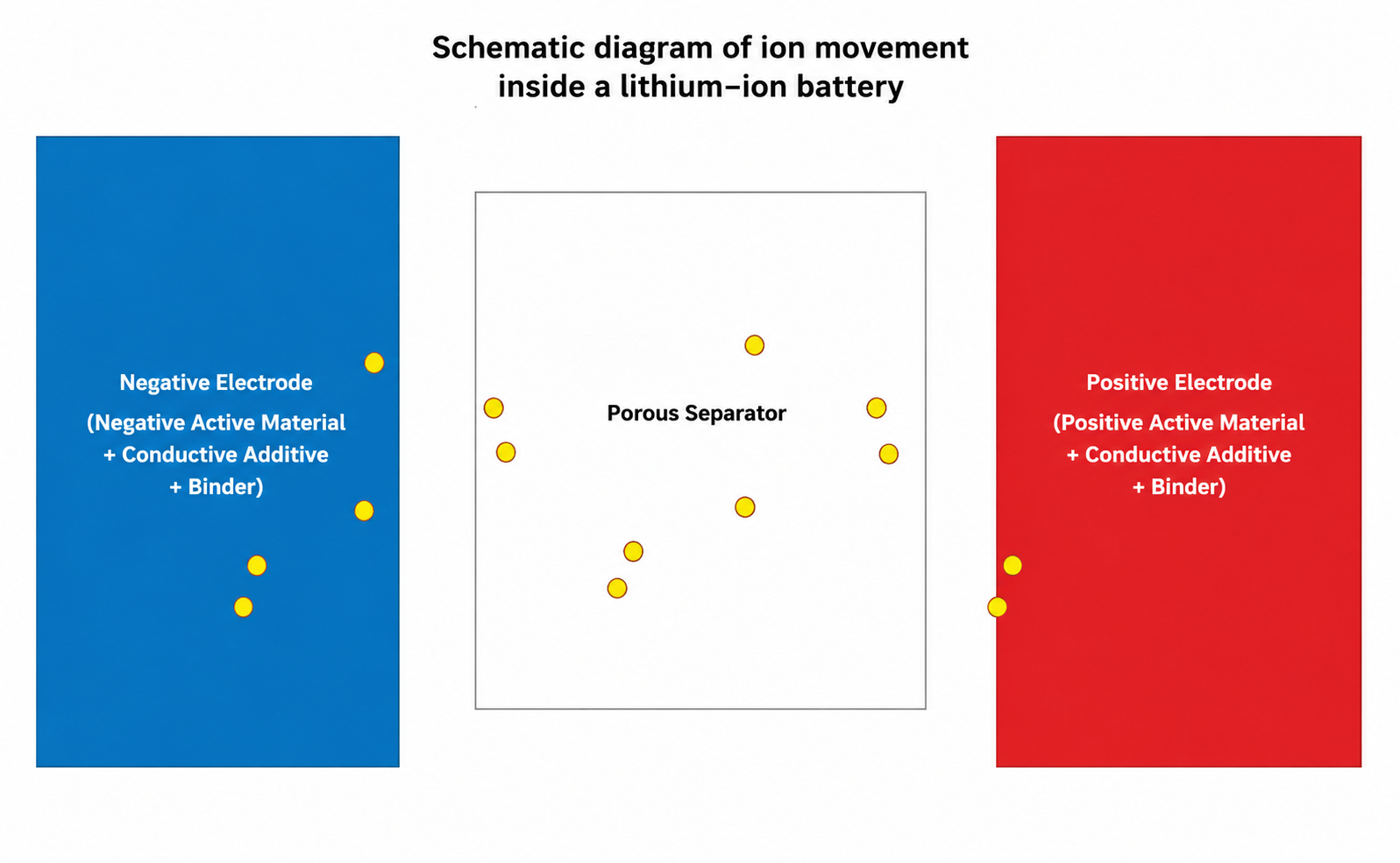
The fundamental reason for the inverse relationship between energy density and C-rate performance lies in the trade-offs involved: to increase energy density, one must select cathode and anode materials with high energy density, maximize the proportion and loading of active materials, minimize the space occupied by inactive components, and increase electrode compaction density—essentially creating “more space for lithium storage” within the battery. However, this directly leads to increased electrode thickness, longer lithium-ion diffusion paths, reduced electrode porosity, and insufficient electrolyte wetting; ultimately, charge-transfer resistance rises sharply, causing a significant drop in C-rate performance. Conversely, to improve C-rate performance, one must select materials capable of high-rate operation, shorten lithium-ion transport paths, reduce interfacial impedance, and enhance electrode conductivity—allowing lithium ions to “move faster.” Yet, this requires thinning the electrodes, reducing active material loading, and significantly increasing the content of inactive components like conductive agents and binders; this compresses the space available for active material to store lithium, inevitably resulting in lower energy density.
Quantitative industry data shows that for batteries of the same chemistry, increasing the cathode areal density from 12 mg/cm² to 24 mg/cm² can boost gravimetric energy density by approximately 32%. However, the capacity retention rate during continuous 10C discharge plummets from 87% to 48%, and the voltage plateau drops by more than 0.5V under high current—a drop sufficient to trigger the drone’s low-voltage protection and create a direct risk of a crash. This represents a core conflict that must be addressed in drone battery design.
II. Balancing Energy Density and Rate Capability
1. Selection of Cathode and Anode Materials: The cathode and anode are the primary sites for lithium-ion intercalation and de-intercalation. The intrinsic specific capacity and ion diffusion coefficient of the materials directly determine the upper limits of energy density and rate capability. However, high specific capacity and high ion diffusion performance are often mutually exclusive; achieving superior rate capability frequently requires sacrificing some energy density—particularly in applications like drone batteries, which demand exceptionally high discharge rates. Materials engineers distinguish between “rate-oriented” and “energy-oriented” materials during the initial design phase, providing options for cell engineers to select from. For instance, an energy-oriented ternary material might achieve a specific capacity exceeding 210 mAh/g at a 0.33C rate, whereas a rate-oriented ternary material might only reach 180 mAh/g at 0.33C but must maintain over 95% of that capacity at a 5C discharge rate.
2. Active Material Proportion and Electrode Structure: Areal density and electrode thickness—areal density refers to the mass of active material per unit area of the electrode. Higher areal density and greater electrode thickness result in a higher proportion of active material and increased battery energy density; however, this also lengthens lithium-ion diffusion paths and increases charge-transfer resistance, thereby degrading rate capability. In other words, achieving high energy density requires loading more cathode and anode material onto the same mass of current collector. For high-rate consumer drone batteries, the cathode areal density is controlled at 12–15 mg/cm² with an electrode thickness of less than 60 μm to ensure peak discharge rates exceeding 10C. Conversely, for long-endurance batteries, the areal density is increased to 18–22 mg/cm² and the thickness to under 100 μm, prioritizing energy density. Compaction density—this refers to the mass of cathode or anode material per unit volume. Higher compaction density increases volumetric energy density; however, excessive compaction reduces porosity, leading to poor electrolyte wetting and fewer pathways for lithium-ion transport, which causes a sharp decline in rate capability. Proportion of Conductive Agents and Binders: Conductive agents (such as carbon nanotubes, graphene, and carbon black) enhance the electronic conductivity of electrodes and are key to improving rate performance. However, since both conductive agents and binders are inactive materials, every 1% increase in their proportion results in a corresponding 1% decrease in the proportion of active materials, thereby reducing energy density. While high-energy batteries typically utilize 2–3% conductive agents in their electrodes, high-rate batteries increase this figure to 4–5%; by employing a composite conductive system—combining carbon nanotubes and graphene—manufacturers can boost rate performance while minimizing the loss of energy density.
III. Outlook on Technological Breakthroughs: The performance ceiling of traditional liquid lithium-ion battery systems is clearly visible. Currently, the highest gravimetric energy density for mass-produced liquid lithium-ion batteries is approximately 350 Wh/kg; however, at this level, rate performance, cycle life, and safety fail to meet the core requirements of drone applications. High-rate liquid lithium-ion batteries typically offer an energy density of around 300 Wh/kg. Can solid-state battery technology fundamentally break the inverse relationship between energy density and rate performance?
1. Semi-solid-state batteries: Semi-solid-state batteries represent the technological pathway currently being adopted for mass production by leading domestic manufacturers. They utilize a “solid-liquid hybrid electrolyte” system that reduces liquid electrolyte usage by over 70%, thereby increasing energy density. Semi-solid electrolytes are compatible with high-nickel ternary cathodes and high-silicon-content anodes, enabling gravimetric energy densities of 320–400 Wh/kg while maintaining strong rate performance. Although many view semi-solid-state batteries merely as an intermediate stage—arguing they cannot significantly boost energy density or fully resolve the safety issues associated with liquid batteries—we believe that technological progress is incremental. All-solid-state batteries still face challenges such as low ion diffusion coefficients, manufacturing difficulties, and high costs. Consequently, semi-solid-state batteries constitute an essential stage in the evolution of the battery industry. 2. All-Solid-State Batteries: These batteries utilize oxide, sulfide, or polymer solid-state electrolytes to completely replace liquid electrolytes, enabling a significant increase in energy density. When paired with high-nickel ternary cathodes and lithium-metal anodes—where the theoretical specific capacity of lithium metal reaches 3,860 mAh/g (more than ten times that of graphite)—the gravimetric energy density of all-solid-state batteries can exceed 500–600 Wh/kg, effectively doubling that of liquid lithium-ion batteries. Among the three types of solid-state electrolytes, sulfide-based electrolytes achieve room-temperature ionic conductivity of 10⁻³ S/cm, comparable to liquid electrolytes; while solid-state electrolytes struggle to surpass liquid ones in terms of conductivity, they allow for increased energy density compared to current high-rate batteries. Regarding safety, all-solid-state batteries offer improvements over liquid-electrolyte batteries but are not entirely free of safety risks. For instance, sulfide solid-state electrolytes react rapidly with water or moisture to release highly toxic hydrogen sulfide (H₂S), and interfacial side reactions can generate gas, leading to battery swelling. Although many manufacturers and automakers are promoting the application of solid-state batteries, mass production remains extremely challenging in the short term; we consider it optimistic to expect mass production by 2030.
3. Supporting Technologies: In addition to solid-state batteries, technologies such as all-tab (or tabless) designs, centered tabs, pre-lithiation, and structural cell integration can effectively mitigate the trade-off between energy density and rate performance. All-tab technology significantly reduces internal cell resistance, minimizes heat generation during high-current discharge, and enables the use of thicker electrodes. Pre-lithiation technology compensates for irreversible capacity loss in silicon-carbon anodes, enhancing the usable capacity and cycle stability of high-silicon anodes, thereby ensuring rate performance while boosting energy density.
The inverse relationship between energy density and rate performance is an intrinsic contradiction within lithium-ion battery systems and a core challenge in drone battery design. When selecting drone batteries, we recommend not over-prioritizing rate performance; it should simply meet the drone’s operational requirements, as an excessive focus on high discharge rates inevitably compromises energy density. Additionally, if the budget allows, semi-solid-state batteries can be considered to increase battery energy density.