
As summer arrives, many drone pilots notice a significant increase in drone range and battery capacity. However, batteries get noticeably hot immediately after landing, and as the weather cools, range decreases significantly. Some batteries even bulge after only a short period of use. Today, we’ll discuss the effects of high temperatures on the internal structure of batteries.

Lithium-ion batteries are extremely sensitive to temperature. The optimal operating temperature range for lithium-ion batteries is between 20°C and 40°C. Once this range is exceeded, the internal electrochemical reactions deviate from their normal course, leading to everything from material decomposition to accelerated side reactions—each factor contributing to a substantial reduction in battery life.
What exactly happens inside a battery at high temperatures? The charging and discharging of a lithium battery is essentially the conversion of chemical energy into electrical energy. Increased temperature accelerates the rate of all chemical reactions, including the acceleration of the main reactions and the simultaneous activation of numerous undesirable side reactions. Most of these side reactions are irreversible; each occurrence permanently reduces the battery’s usable capacity and lifespan.
At high temperatures, the diffusion rate of lithium ions increases, and the chemical reaction rate also increases, thus reducing the battery’s internal resistance and increasing its usable energy. This explains the increased range at high temperatures. However, the negative impacts of high temperatures are even greater. Firstly, there’s the SEI film. The SEI film is a thin solid electrolyte interface layer on the surface of the graphite negative electrode. Its function is to protect the graphite structure from electrolyte erosion while allowing lithium ions to pass freely. At room temperature, the SEI film is in a relatively stable state with an extremely slow growth rate. However, at high temperatures, the decomposition rate of the electrolyte increases exponentially, and decomposition products continuously deposit on the SEI film, causing the film layer to thicken continuously. More seriously, drone batteries frequently discharge at high currents. During high-temperature, high-current discharges, severe local polarization occurs at the negative electrode, leading to localized ruptures in the SEI film. After rupture, the electrolyte directly contacts the fresh graphite surface, immediately reacting to form a new SEI film. This rupture-repair process continuously consumes electrolyte and active lithium. Active lithium is the carrier of battery capacity; each portion consumed permanently reduces the battery’s usable capacity.
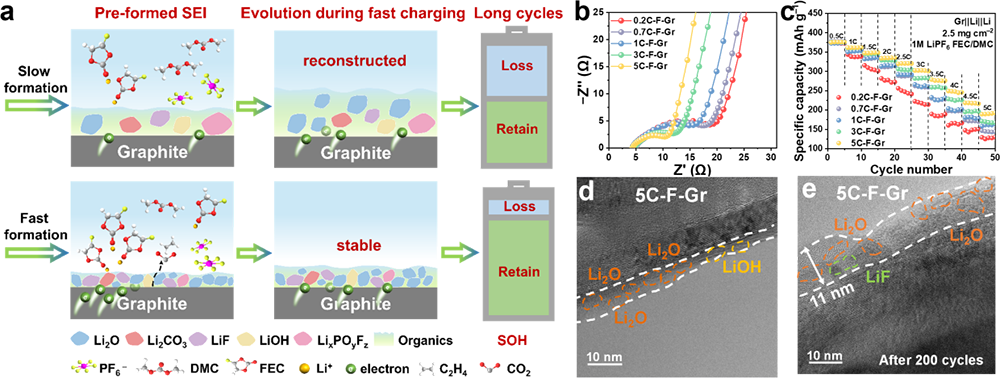
Secondly, there is the decomposition and gas production of the electrolyte. Lithium-ion battery electrolytes consist of lithium salts and organic solvents, which are inherently unstable at high temperatures. Above 55°C, the decomposition rate accelerates significantly. Electrolyte decomposition produces gases such as carbon dioxide, methane, and ethane. These gases become trapped inside the battery, resulting in the battery bulging we observe. Electrolyte decomposition not only produces gas leading to bulging, but more importantly, the electrolyte itself is the medium for lithium-ion transport. After the electrolyte is consumed, the ionic conductivity inside the cell decreases, internal resistance increases further, and heat generation during discharge becomes more severe, forming a positive feedback loop of “increased temperature – electrolyte decomposition – increased internal resistance – more severe heat generation.” This is the fundamental reason why many batteries get hotter and experience faster capacity degradation with use.
Regarding the positive electrode material, the electrolyte reacts with trace amounts of water in the battery to produce hydrofluoric acid. This hydrofluoric acid reacts with and corrodes the positive electrode material, inevitably reducing its capacity after decomposition. Furthermore, after the positive electrode material decomposes, metals such as nickel, cobalt, and manganese are deposited through the electrolyte to the negative electrode, damaging the SEI film and consuming active lithium to generate new SEI, leading to a decrease in active lithium and capacity. The inherently unstable structure of ternary materials will slowly transform into a capacity-less rock salt phase. High temperatures accelerate this structural transformation and release active oxygen, reducing battery safety.
Finally, there is an overall increase in internal resistance. Thickening of the SEI film, reduction of electrolyte, and degradation of the positive electrode structure all ultimately manifest as increased internal resistance. Increased internal resistance leads to more severe heat generation during discharge—Joule heating is directly proportional to internal resistance; the higher the internal resistance, the more heat is generated for the same current, and the faster the temperature rises, which in turn accelerates all the aforementioned side reactions, creating a vicious cycle.
In summary, high temperatures accelerate internal side reactions within the battery, potentially resulting in a slight increase in battery capacity in the short term. However, over the long term, the defects caused by increased internal resistance will gradually become apparent, significantly reducing battery life.
How to protect drone batteries? The core strategy for cooling is “reducing heat generation + accelerating heat dissipation + avoiding high-temperature operating conditions.”
When purchasing drone batteries, try to buy batteries with low internal resistance, as internal resistance directly determines heat generation. Regarding heat dissipation, most small drones do not have a cooling system; heat dissipation is mainly achieved through natural air convection. Covering drone batteries with heat-shrink film or foam tape will reduce heat dissipation, so batteries can be used directly after purchase without further “additional processing.” The battery compartment should have adequate ventilation holes to increase battery heat dissipation. Additionally, the propeller airflow should be utilized effectively for battery cooling.
During flight, cooling is achieved by reducing the discharge rate, as high-current discharge is the primary source of battery heat. In hot weather, minimize high-rate discharge maneuvers such as full-throttle climbs, high-speed forward flights, and aggressive maneuvers. Maintain stable cruising, keeping the discharge rate below 2-3C to significantly reduce battery heat generation. Secondly, carefully control the flight time per sortie. Avoid repeatedly depleting the battery to low battery warning levels before returning to base. Shallow discharge and charging not only extend battery life but also prevent continuous overheating under high load. Furthermore, in hot weather, choose to operate during the cooler morning and evening hours, avoiding the midday heat. A 10°C difference in ambient temperature can significantly impact battery operating temperature and aging rate.
Post-flight cooling is often overlooked. Upon landing, the internal temperature of the battery cells is typically above 45°C, and can even reach 55-60°C during high-load flights. Under these conditions, immediate charging is strictly prohibited. High-temperature charging exacerbates both lithium plating on the negative electrode and electrolyte decomposition. The lifespan damage caused by a single high-temperature charge is far greater than that caused by a single high-temperature discharge. The correct approach is to place the battery in a cool, well-ventilated area for 15 minutes after landing, allowing the cell temperature to drop below 35°C before charging. If you’re in a hurry, you can use a fan to blow air onto the battery to accelerate heat dissipation.
Temperature control is also crucial during charging. The charger itself generates heat during charging; avoid stacking batteries and chargers together, and keep them separate and well-ventilated. In summer, opt for 1C standard rate slow charging whenever possible. High-current fast charging generates more heat, and combined with high ambient temperatures, the internal temperature of the cell can easily exceed the limit. Use slow charging for routine maintenance and fast charging for emergencies; this balances efficiency and lifespan. If possible, maintain the charging environment at around 25°C; charging in an air-conditioned room is most battery-friendly.
Batteries used frequently in summer should be inspected regularly. If slight bulging is found, immediately downgrade the battery and avoid using it for high-load operations. Batteries that will not be used for a long time should be charged to a storage voltage of around 3.8V and stored in a cool, dry place, avoiding full-charge storage.
Summer is the season when drone batteries experience the fastest degradation, but by understanding the underlying mechanisms by which high temperatures affect batteries and implementing proper cooling and protection measures at each stage, the lifespan loss caused by high temperatures can be minimized.