
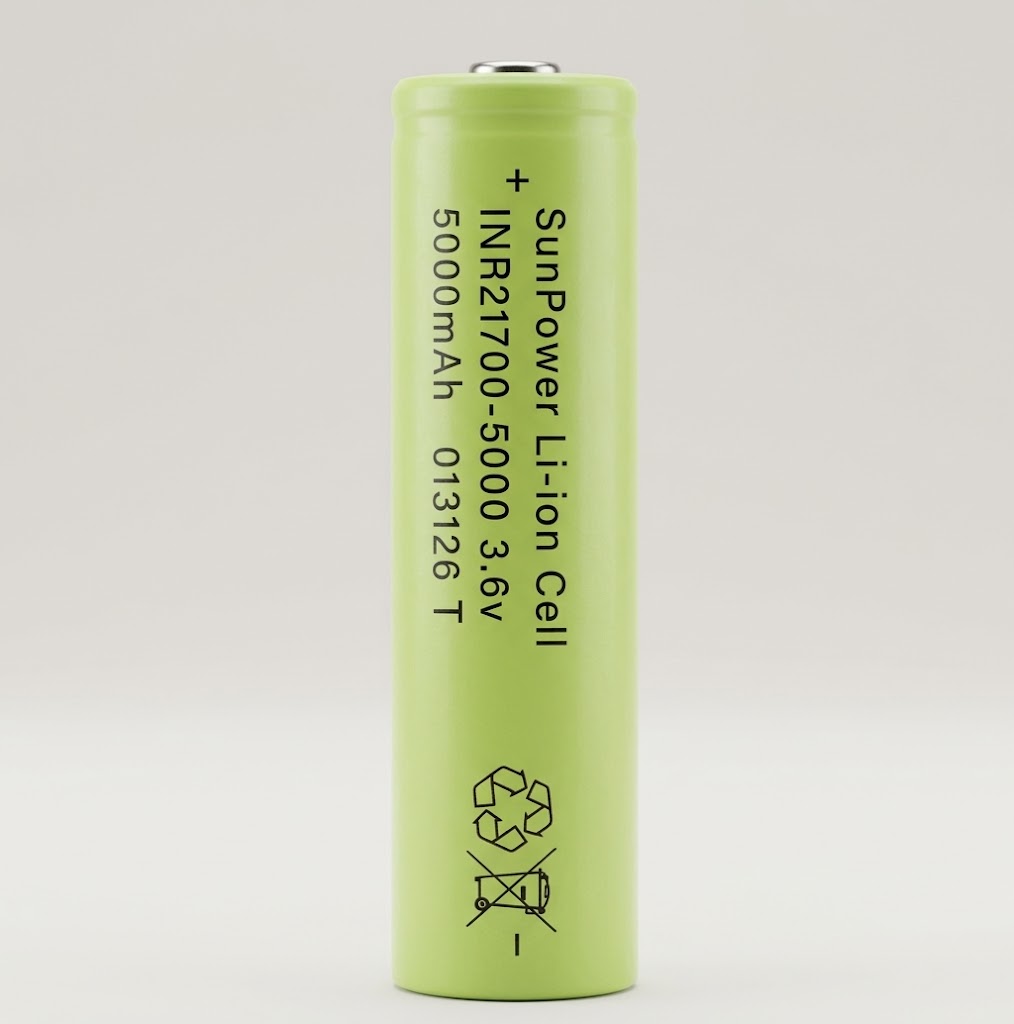
When your equipment needs more runtime without moving to a larger battery format, choosing the right cell becomes critical. A 21700 lithium battery series can provide a practical balance between capacity, current output, size, and system integration. For applications that require a rechargeable cylindrical cell with high capacity and strong discharge capability, you need clear electrical specifications rather than generic battery claims. Shenzhen Defond Technology Co., Ltd. provides the 21700-50T, a 3.6V Li-ion cell with 5000mAh capacity, 20A maximum continuous discharge, and 90A pulse discharge for 2 seconds. These specifications make it suitable for battery systems where both energy capacity and short-duration power demand matter.
21700 Lithium Battery Series Specifications
The 21700-50T uses a cylindrical lithium-ion cell format with a nominal voltage of 3.6V. Its 5000mAh capacity provides a higher energy capacity than many commonly used 18650 cells, while its discharge specifications support applications with demanding current requirements.
| Specification | 21700-50T |
|---|---|
| Cell Type | Lithium-ion |
| Model | 21700-50T |
| Cell Format | 21700 cylindrical cell |
| Nominal Voltage | 3.6V |
| Capacity | 5000mAh |
| Operating Temperature | -20°C to 60°C |
| Max. Continuous Discharge | 20A |
| Max. Pulse Discharge | 90A for 2 seconds |
The 20A continuous discharge rating is particularly relevant when your battery system must maintain stable current under sustained loads. Meanwhile, the 90A pulse discharge rating addresses short-duration power demands, although actual system design should account for temperature, wiring, BMS configuration, and operating conditions.
Why Choose a 21700 Li-ion Cell?
Compared with the smaller 18650 format, the 21700 form factor offers greater physical volume per cell, allowing manufacturers to design cells with higher capacity. However, the right cell depends on your required voltage, current, thermal conditions, battery dimensions, and pack architecture.
For your battery design, the 21700-50T can be considered when you need:
- 5000mAh cell capacity for higher-capacity battery configurations
- 20A continuous discharge for sustained current requirements
- 90A/2s pulse discharge for short-duration high-current demands
- -20°C to 60°C operating temperature for a broad ambient operating range
- A rechargeable lithium-ion cylindrical cell for customized battery systems
21700 Battery Cells vs. 18650 Battery Cells
If you are evaluating different cylindrical battery formats, capacity and system requirements should guide the selection rather than cell size alone.
| Factor | 21700-50T | Typical 18650 Cell |
|---|---|---|
| Cylindrical format | 21700 | 18650 |
| Nominal voltage | 3.6V | Application-dependent |
| Capacity | 5000mAh | Varies by model |
| Continuous discharge | Up to 20A | Varies by model |
| Pulse discharge | Up to 90A/2s | Varies by model |
| Application focus | High-capacity/high-current systems | Compact battery systems |
| Pack design | Suitable for customized configurations | Suitable for customized configurations |
The comparison shows why you should evaluate the actual electrical specifications of each cell model rather than assuming every 21700 or 18650 cell performs the same way.
How to Select a 21700 Lithium Battery Series
Before integrating a 21700 lithium battery series into your product, follow a structured evaluation process:
- Define the load profile
Identify your nominal operating current, peak current, required runtime, and duty cycle. - Calculate the required capacity
Use your expected energy consumption and operating time to determine the required cell and pack capacity. - Check discharge requirements
Compare continuous and pulse current requirements with the cell’s rated discharge performance. - Evaluate operating conditions
Confirm that the expected ambient temperature remains within the cell’s specified -20°C to 60°C range. - Design the battery system
Determine the series and parallel configuration, BMS requirements, protection strategy, and thermal management. - Validate the complete pack
Test the finished battery under the actual application’s load, temperature, charging, and discharge conditions.
This approach helps you avoid selecting a cell based only on its advertised capacity.
Defond 21700 Battery Cell Manufacturing Support
Shenzhen Defond Technology Co., Ltd. specializes in integrated battery solutions covering cells, BMS, and PACK. Founded in 2016, the company develops battery technologies for drone and other demanding applications and serves customers across more than 30 countries and regions.
For buyers evaluating a 21700 battery manufacturer or supplier, manufacturing capability and quality management are important parts of supplier qualification. Defond states that its production and management systems are certified to ISO9001 and ISO14001, while its R&D resources include technical laboratories and dedicated new-energy research facilities.
Defond can also support customers beyond individual cells when a project requires battery-system integration. Its capabilities cover customized battery development, BMS development, and PACK manufacturing, allowing you to evaluate the cell together with the requirements of the final battery system.
FAQ
Is the 21700-50T a rechargeable battery cell?
Yes. The 21700-50T is a rechargeable lithium-ion cylindrical cell with a nominal voltage of 3.6V and a rated capacity of 5000mAh.
What is the maximum discharge current of the 21700-50T?
The specified maximum continuous discharge current is 20A. Its maximum pulse discharge current is 90A for a 2-second pulse. Your final battery design should consider the BMS, thermal conditions, interconnections, and application load.
Can the 21700-50T be used in a customized battery pack?
The cell can be evaluated as a component for customized battery configurations. If you need a complete battery solution, Defond also provides cell, BMS, and PACK integration, allowing you to discuss the required voltage, capacity, current, dimensions, and application conditions.
Conclusion
Choosing a 21700 lithium battery series requires more than comparing nominal capacity. The 21700-50T combines a 3.6V nominal voltage, 5000mAh capacity, 20A continuous discharge capability, and 90A/2-second pulse discharge specification, giving you a defined starting point for high-capacity and high-current battery system development. With its cell, BMS, and PACK capabilities, Shenzhen Defond Technology Co., Ltd. can also support projects that require integration beyond the individual cell.
CTA
If you are developing a customized battery pack, share your required voltage, capacity, continuous current, peak current, operating temperature, dimensions, and application with Defond. The engineering team can evaluate the 21700-50T against your battery requirements and discuss the appropriate cell, BMS, and PACK configuration.